
We will pick you up 4:30 in the morning from the hotel in Cusco, we will travel south on the road that leads to the province of Canas, during the journey we will observe the Pomacanchi lagoon - the enigmatic Urcos lagoon, where the stories tell us that the last Inca ordered to take all the gold of the Empire so that it is not sacked by the Spaniards and the Yanaoca lagoon, where we will visit a somewhat tiny volcano and the open one of the same name
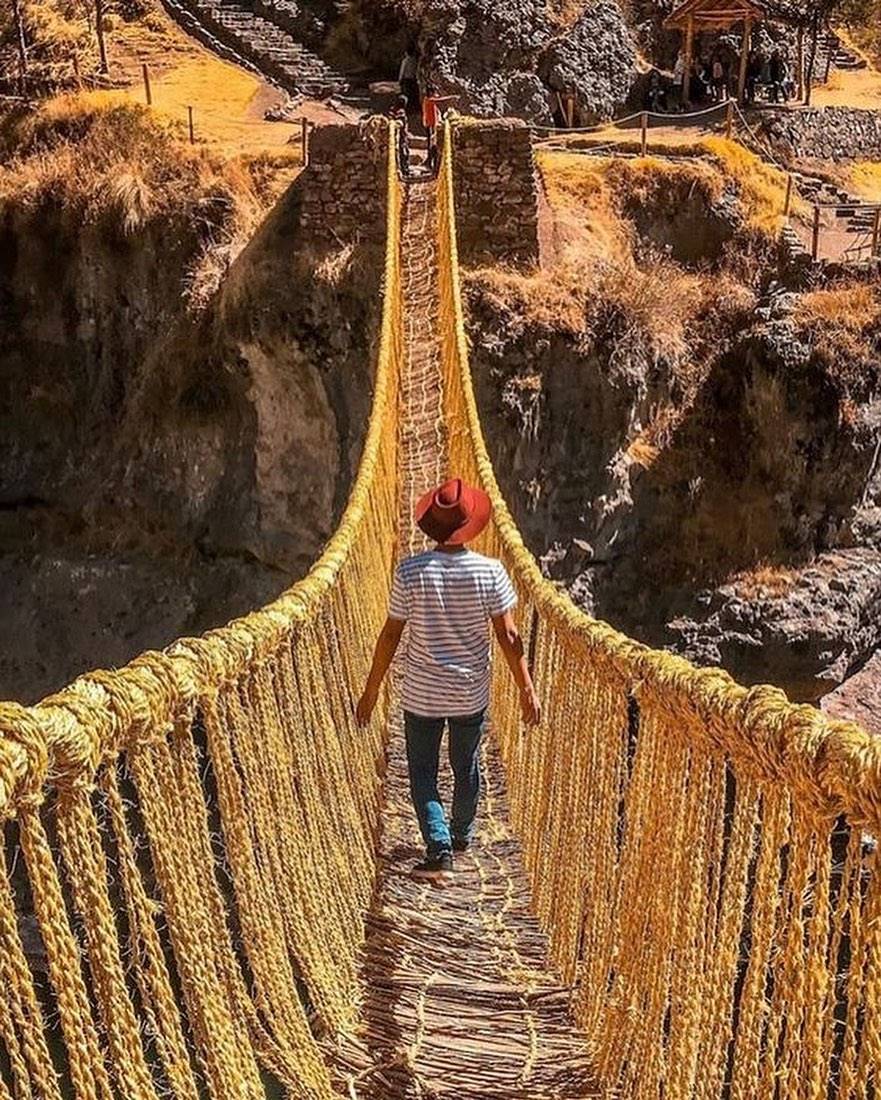
Upon arriving at "Queswachaca" located at (3,600 masl.) We will have the opportunity to visit its ancestral bridge, which is an architectural and cultural heritage of the Incas, the Inca bridge of "Queswachaca" is built on the majestic Apurimac River, located in the province of Canas. The last Inca bridge undergoes the deterioration of its material (straw) due to the harsh climate of the mountains, so it requires annual maintenance consisting of a total reconstruction. The reconstruction is in charge of the rural communities of Perccaro, Huinchi and Qqewe. The dimension of the bridge is 33 m. long and 1.20 m. wide, the material used is only the straw (Ichu) braided from the heights of the region "Puna 4,200 \ 5,200 masl".
In the afternoon we will return to Cusco, but the road has a surprise, at the height of the community of Hampatura are the impressive caves of Ccarañahui or Q'arañahui which is located at 3,900 meters above sea level. This is a fantastic cavern of marine sedimentary material, its chemical composition is calcium hypochlorite, which by the constant dripping resulted in the formation of impressive stalagmites and stalactites, which curiously acquired forms of puma, and condor, the cave has thousands of years old and in the background we can appreciate a mysterious lagoon, says the legend that the Incas went to the cave to communicate spiritually with their Gods. Finally we will return to Cusco in our private car, ending our tour to the Inca bridge of "Q'eswachaka"
The bridge of "Q'eswachaka" requires annual maintenance because the straw (Ichu) used for its construction begins to decompose, since the Inca era the reconstruction is carried out in 3 days (before the second Sunday of June) and On the 4th day the ceremony concludes with a folk festival, where you can share the traditions and customs unique in the world.

 Reservar aquí